Flight Yoke · Microsoft Flight Simulator 2024
Logitech G Pro Flight Yoke
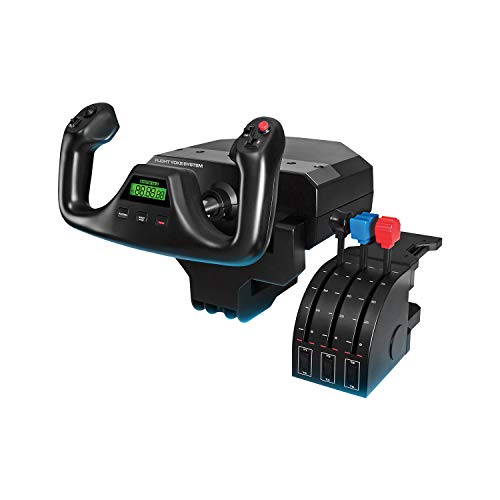
- Budget
- PC
- Throttle quadrant included
This page contains affiliate links. As an Amazon Associate we earn from qualifying purchases.
MSFS Performance Score
- Feel & Centering25% 80
- Controls in the Box25% 50
- Sensors20% 40
- Platforms15% 50
- Build Quality15% 70
Biggest contributor: feel and centering (25% of the score), rated 80/100. How we score
Verdict for MSFS
The Logitech G Pro Flight Yoke suits PC simmers moving up from a gamepad who want a yoke plus a 3-lever throttle quadrant in one box, so you can set power by hand for the climb. Logitech doesn't say it uses contactless Hall-effect sensors, and there's no trim wheel or rudder axis.
Updated October 2026
Pros & Cons for MSFS
Strengths
- The throttle quadrant in the box gives you three levers, so you can push power up for takeoff, pull it back abeam the numbers and set mixture on a Cessna without hunting for a keyboard key.
- There are 25 programmable inputs across the yoke and quadrant, enough to put gear, flaps, lights and autopilot disconnect under your fingers while you're hand-flying a 737 approach.
- With 180 degrees of roll and a steel shaft in the column, it fits light singles and airliners alike, and it grows sensibly later: add rudder pedals and you can taxi with your feet and kick out the drift in a crosswind landing.
Trade-offs
- It's an older design and owners often mention a slight notch right around center on the pitch axis, which can make tiny nose-down corrections on short final feel like they catch before they move; a small dead zone in MSFS (a sliver of travel where the sim ignores the yoke) hides most of it.
- Logitech doesn't state contactless Hall-effect sensors, the kind that read position without parts rubbing, so an older unit can get jittery and need a recalibration — and there's no trim wheel here, so you trim with buttons instead of rolling off the pressure by hand in the climb. The next step up in price can buy contactless sensors, a trim wheel and longer pitch travel.
Full Specifications
- Sensors
- Not stated by the maker
- Throttle
- Its own throttle quadrant
- Throttle levers
- 3
- Trim wheel
- No
- Rudder controls
- Needs rudder pedals
- Centering
- Springs
- Roll
- 180°
- Build
- Hybrid
- Buttons
- 25
- Works on
- PC
- Released
- 2016
Frequently Asked Questions
Is this a good Flight Yoke for MSFS?
Yes, for a PC simmer who wants a yoke and a throttle quadrant together without fuss, and it scores 58.5/100 for MSFS. It shines in GA flying, where the three levers let you manage power, prop and mixture by hand while you hold altitude in a Cessna. It shows its age in the fine detail: no trim wheel, no stated contactless sensors and a centering spring that can feel notchy near center.
Is it worth the price for MSFS?
For the money you get two pieces of hardware instead of one, and that's the main reason to pick it over a bare yoke that still leaves you reaching for keys to set power. Spend more and you're paying for contactless sensors, a built-in trim wheel, longer pitch travel and more metal inside, none of which this one offers.
Does it work on Xbox or PS5?
It's PC only, so it works with MSFS 2024 on Windows and nothing else. MSFS also runs on Xbox Series X|S and PS5, but Xbox only accepts controls licensed for Xbox and the only yoke supported on PS5 is the Thrustmaster TCA Sky Yoke (PS5 version), while Xbox Cloud Gaming doesn't take yokes at all.
What else do I need with it?
The throttle quadrant is already in the box, but there are no rudder controls at all, so add rudder pedals if you want to steer on the taxiway and line up the nose in a crosswind landing — otherwise you're on keyboard rudder. You'll also want a solid desk edge to mount it to, since a flexing desk makes the whole column wobble when you pull back to rotate.
How should I configure this in MSFS?
In MSFS, check the control profile first and make sure pitch and roll are assigned and not reversed — pull back and the nose should come up. Then add a small dead zone around center to hide the notch on the pitch axis, soften the sensitivity curve if it feels twitchy, and map trim up and trim down to a pair of yoke buttons, because there's no trim wheel to roll.