X-Plane 12
Best Monitor for X-Plane 12
X-Plane 12 runs natively on ultrawide screens and supports several monitors, but every extra pixel is work for the graphics card, so match the screen to your card. Every monitor below was sold by Amazon itself when we last checked the picks.
This page contains affiliate links. As an Amazon Associate we earn from qualifying purchases.
9 monitors at a glance
| # | Monitor | Score | Price |
|---|---|---|---|
| 1 | LG UltraGear 45GX900A Best overall · High-End · 45" · 1440p | 89.3 /100 | Check price |
| 2 | Samsung Odyssey G9 (49-inch) High-End · 49" · 1440p | 83.8 /100 | Check price |
| 3 | Alienware AW3425DW High-End · 34" · 1440p | 80.5 /100 | Check price |
| 4 | Samsung Odyssey OLED G7 (32-inch 4K) High-End · 32" · 4K | 76.4 /100 | Check price |
| 5 | LG UltraGear 34G600A Mid-Range · 34" · 1440p | 71.8 /100 | Check price |
| 6 | Dell S3225QS Mid-Range · 31.5" · 4K | 67.3 /100 | Check price |
| 7 | Samsung Odyssey G5 (27-inch) Budget · 27" · 1440p | 59.9 /100 | Check price |
| 8 | LG UltraGear 32GS60QC Budget · 31.5" · 1440p | 59.8 /100 | Check price |
| 9 | Dell SE2426HG Best budget · Budget · 23.8" · 1080p | 50.0 /100 | Check price |







All Monitors Ranked for X-Plane 12
- #1 Best overall
LG UltraGear 45GX900A
- High-End
- 45"
- 1440p
- OLED
89.3 /100 X-Plane 12 scoreThe LG UltraGear 45GX900A suits simmers who want more of the view out of the side windows, on a 45-inch ultrawide 3440 × 1440 OLED curved at 800R. It asks a lot of your graphics card, and at 83 pixels per inch small instrument text looks soft if you sit close.
Strengths and trade-offs
Strengths
- The OLED panel switches each pixel off for true black, so a night approach into a lit-up city shows runway lights and city glow against a genuinely dark sky instead of the grey haze an LCD gives you.
- 240 Hz with variable refresh keeps the horizon smooth and tear-free when you bank hard in a pattern turn, and the 2-year warranty specifically covers the OLED panel.
- 3440 × 1440 is 5 million pixels, far less work than a 4K ultrawide, so a strong current graphics card with plenty of video memory can fill all 45 inches while you still run X-Plane 12's clouds and lighting up high.
Trade-offs
- OLED needs a little care on long flights: a static panel overlay, frozen G1000 screen or a parked map window left on screen for hours is exactly the kind of fixed image to avoid, so let the monitor run its pixel-refresh routines and don't leave the sim paused all day.
- At 83 pixels per inch the image is soft up close — radio frequencies and small switch labels aren't as crisp as on the higher-resolution ultrawides that cost the next step up in price, so you'll zoom the cockpit view or sit back a bit.
- #2
Samsung Odyssey G9 (49-inch)
- High-End
- 49"
- 1440p
- VA
83.8 /100 X-Plane 12 scoreThe Samsung Odyssey G9 (49-inch) suits simmers who want the whole horizon in view, with 5120 × 1440 on a 49-inch 32:9 curved panel that fills your side windows. It leans hard on your graphics card, so plan on lowering render scaling if yours is a few generations old.
Strengths and trade-offs
Strengths
- The VA panel's deep blacks make a night approach into a lit city look right, with the runway lights standing out instead of floating in grey haze, and 5120 × 1440 keeps the PFD and radio stack readable without leaning in.
- The 1000R curve here wraps the 32:9 view around you, so on a low VFR leg down a valley you catch the ridge out of the left window with your eyes, not the hat switch, and 144 Hz with variable refresh keeps the scenery sliding past smoothly as frames rise and fall.
- It pairs well with a current strong graphics card and a sim rig built for one screen rather than three, since X-Plane 12 drives the whole 32:9 width as one window, so there are no bezels splitting the horizon on a hand-flown circuit.
Trade-offs
- 7.4 million pixels is a lot to push, and X-Plane 12 leans on the graphics card more than most sims, so dense airports with heavy cloud will have you trimming render scaling or cloud detail before anything else.
- Step up in price and you get per-pixel OLED lighting, which cleans up the slight dark smear VA panels can show when you pan fast over night terrain, and higher refresh rates; this panel tops out at 144 Hz.
- #3
Alienware AW3425DW
- High-End
- 34"
- 1440p
- OLED
80.5 /100 X-Plane 12 scoreThe Alienware AW3425DW suits X-Plane 12 pilots who want more out of the side windows, with 3440 × 1440 on a curved 34-inch OLED panel. It asks a lot of your graphics card, and OLED needs simple burn-in habits on long flights.
Strengths and trade-offs
Strengths
- The OLED panel shows true black, so a night approach into a lit-up city reads as real darkness with the runway lights floating in it, not a grey wash — and dimmed instrument backlighting stays legible instead of glowing.
- 240 Hz with variable refresh keeps a hand-flown crosswind landing smooth as the frame rate moves around, and the 3-year warranty covers burn-in, which matters when a cockpit view sits on screen for hours.
- At 5 million pixels, this is easier on a graphics card than a taller, denser panel while still looking sharp at 110 pixels per inch, so a strong current card can hold detailed scenery on a low pass down a valley.
Trade-offs
- X-Plane 12's Vulkan renderer leans hard on the graphics card, and filling an ultrawide over dense photoscenery will push a mid-pack card — expect to pull render scaling or texture detail back on a busy approach.
- Step up in price and you can get a bigger, taller panel or a denser one; here the 34-inch 21:9 shape shows less sky above the glareshield, and small glass-cockpit text is slightly softer than on a higher-resolution screen.
- #4
Samsung Odyssey OLED G7 (32-inch 4K)
- High-End
- 32"
- 4K
- OLED
76.4 /100 X-Plane 12 scoreThe Samsung Odyssey OLED G7 (32-inch 4K) suits X-Plane 12 pilots who want sharp instruments and deep night contrast on a 32-inch 3840 × 2160 OLED panel. You need a strong graphics card to drive all those pixels, and OLED asks for some burn-in care.
Strengths and trade-offs
Strengths
- 3840 × 2160 across 32 inches works out to 138 pixels per inch, so runway numbers, taxiway signs and small radio stack digits stay readable without leaning toward the screen or zooming the panel.
- The OLED panel switches pixels fully off, so a night approach into a lit-up city keeps genuinely black sky instead of a grey glow, and 165 Hz with variable refresh keeps a low pass over ridges smooth as the frame pace moves around.
- It is a plain 16:9 shape, so X-Plane 12 fills it at native resolution with no window fiddling, and it pairs well with a single strong modern graphics card where an ultrawide of the same sharpness would ask for more card.
Trade-offs
- Feeding 8.3 million pixels through X-Plane 12's Vulkan renderer leans hard on your graphics card over dense city scenery, and OLED wants care too — hide the taskbar and change your cockpit view now and then on a long cruise.
- The panel is flat and 16:9, so you do not get the wrapped side-window view a curved ultrawide gives on a VFR leg; that shape is the next step up in price.
- #5
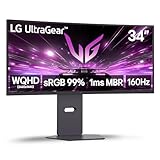
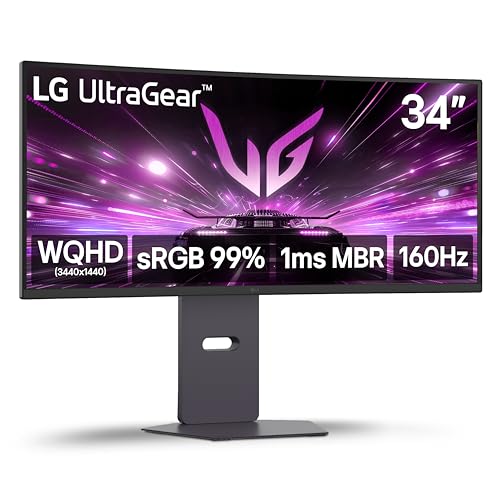
LG UltraGear 34G600A
- Mid-Range
- 34"
- 1440p
- VA
71.8 /100 X-Plane 12 scoreThe LG UltraGear 34G600A suits X-Plane 12 pilots who want more of the view out of the side windows, with 3440 × 1440 on a curved 34-inch VA panel. Driving those 5 million pixels needs a capable graphics card, and text sits a little softer up close than on a smaller screen.
Strengths and trade-offs
Strengths
- The 3440 × 1440 ultrawide shape lets you keep the runway in sight through the left window as you turn base, and at 110 pixels per inch the radio stack and heading bug stay readable without leaning in.
- The VA panel holds deep blacks, so a night approach into a lit-up city shows real black sky around the approach lights instead of a grey wash.
- 160 Hz with variable refresh (G-Sync Compatible or FreeSync) keeps an external orbit of your aircraft smooth when X-Plane 12's frame pacing wobbles, so it earns its keep paired with a recent graphics card rather than feeling wasted.
Trade-offs
- 5 million pixels is real work for X-Plane 12's Vulkan renderer, which leans on the graphics card harder than most sims, so over dense city scenery you'll likely pull back shadow detail or render scaling to keep things smooth.
- The next step up in price buys you either a sharper 4K-class ultrawide or an OLED with faster pixel response; here, fast panning across dark terrain can leave a faint trail, and distant runway markings aren't as crisp as on a denser panel.
- #6
Dell S3225QS
- Mid-Range
- 31.5"
- 4K
- VA
67.3 /100 X-Plane 12 scoreThe Dell S3225QS suits X-Plane 12 pilots who want sharp cockpit gauges and a clean view outside, with 3840 × 2160 pixels across a 32-inch flat screen. The trade-off is load on your graphics card, since 8.3 million pixels is a lot to draw every frame.
Strengths and trade-offs
Strengths
- At 140 pixels per inch, 3840 × 2160 on a 32-inch panel keeps small text crisp, so radio frequencies and FMC lines stay readable without leaning into the screen on an approach briefing.
- The VA panel renders deep blacks, so a night descent into a lit-up city shows runway lights and apron glow against dark terrain instead of a grey haze — and the 120 Hz refresh with variable refresh is more than most screens at this resolution give you for the money.
- It pairs well with a graphics card that has a generous amount of video memory, which is what X-Plane 12's Vulkan renderer wants when you fly a detailed airliner into dense scenery.
Trade-offs
- Driving all 8.3 million pixels is hard work for X-Plane 12, so with weather and heavy ground scenery you may need to pull render scaling back below native.
- It is flat and 16:9, so you miss the extra side view that a curved ultrawide gives on a VFR circuit — X-Plane 12 handles ultrawide natively, and that is what the next step up in price buys you.
- #7
Samsung Odyssey G5 (27-inch)
- Budget
- 27"
- 1440p
- IPS
59.9 /100 X-Plane 12 scoreThe Samsung Odyssey G5 (27-inch) suits simmers who want sharp instrument panels on a desk-friendly screen, with 2560 × 1440 on a flat 27-inch IPS panel. It asks more of your graphics card than a lower-resolution screen, and spending more would buy a wider view out of the side windows.
Strengths and trade-offs
Strengths
- At 109 pixels per inch, the 2560 × 1440 panel keeps radio stack digits and small gauge labels readable on an instrument approach, so you stop leaning in to zoom on the autopilot panel.
- The IPS panel holds its colour when you glance off to the corner of the screen at a side window view, and 180 Hz with variable refresh smooths the uneven pacing X-Plane 12 shows over dense scenery.
- 3.7 million pixels is a sensible target for a single mainstream graphics card, which matters in X-Plane 12 because it leans on the graphics card harder than other sims when you fly low over a detailed city.
Trade-offs
- It is a flat 16:9 screen, so on a VFR leg down a coastline you only see what's out the front windscreen — the side windows stay off-screen unless you pan the view.
- The next step up in price gets you a curved 3440 × 1440 ultrawide, which fills your peripheral vision in the circuit; this panel also has no deep-black trick, so a night approach into a lit-up city shows grey rather than true black sky.
- #8
LG UltraGear 32GS60QC
- Budget
- 31.5"
- 1440p
- VA
59.8 /100 X-Plane 12 scoreThe LG UltraGear 32GS60QC suits simmers who want a big cockpit view without jumping to 4K: 32 inches of 1440p with a 1000R curve that wraps around you. Its VA panel gives deep blacks for night flying, but small gauge text looks softer up close than on a sharper screen.
Strengths and trade-offs
Strengths
- The VA panel holds deep blacks, so a night approach into a lit city keeps the dark countryside properly dark instead of grey, and the runway lights stand out against it.
- 180 Hz with variable refresh keeps a low-level turn over terrain smooth and tear-free.
- At 2560 x 1440 it asks far less of your graphics card than a 4K screen, so a mid-power card can hold detailed scenery and clouds on a heavy airliner approach instead of being dragged down by pixel count.
Trade-offs
- Sharpness is only fair at 93 pixels per inch, so when you lean in to read a GPS page or a small engine gauge, the text looks slightly soft compared with a 4K panel of the same size.
- Spending more gets you either 4K crispness on distant runway markings or a 21:9 ultrawide shape, which X-Plane 12 runs natively and which would show more out of the side windows on a VFR circuit.
- #9 Best budget
Dell SE2426HG
- Budget
- 23.8"
- 1080p
- IPS
50.0 /100 X-Plane 12 scoreThe Dell SE2426HG is a 23.8-inch 1080p IPS screen for simmers who want smooth, easy-to-run flying in X-Plane 12 without a big graphics card. At 93 pixels per inch, small instrument labels look soft up close, and the next step up in price buys a sharper, wider view.
Strengths and trade-offs
Strengths
- 1920 × 1080 on a 23.8-inch panel is the lightest load you can give X-Plane 12's Vulkan renderer, so the graphics card can spend its effort on cloud layers and ground detail during a dusk approach instead of on pixel count.
- The IPS panel holds its colour when you lean in or glance sideways at the radio stack on a VFR circuit.
- 240 Hz with variable refresh (G-Sync Compatible or FreeSync) keeps the horizon steady when you roll into a steep turn and stops the picture tearing when the scene gets heavy over a big city, which makes it a sensible match for a graphics card that is a couple of generations old.
Trade-offs
- At 93 pixels per inch, glass-cockpit text and small approach chart numbers look soft from a normal desk distance, so you will zoom the panel view more often than you would on a sharper screen.
- You don't get the extra width of an ultrawide, which X-Plane 12 runs natively, nor a curve: on this flat 16:9 panel the side windows stay out of frame on a low-level VFR leg, and a higher-resolution screen would also crisp up the instruments.




Frequently Asked Questions
What is the best monitor for X-Plane 12?
LG UltraGear 45GX900A-B 45-Inch WQHD OLED Curved Gaming Monitor, 240Hz leads with a score of 89/100, making it the top pick for 2026.
How much should I spend on a monitor for X-Plane 12?
The lowest-priced pick we rank is the Dell SE2426HG (50/100). From the Dell S3225QS (67/100) upward you get a better balance of build quality and features. Prices change daily, so check the current price with each Amazon button.
Does X-Plane 12 support monitors?
Yes — X-Plane 12 natively supports monitors. LG UltraGear 45GX900A-B 45-Inch WQHD OLED Curved Gaming Monitor, 240Hz is our top-rated option with a score of 89/100.
What should I look for in a monitor for X-Plane 12?
Prioritize Resolution (30% of scoring) and Panel type (25%) when choosing monitors for flight simulation. These factors have the greatest impact on feel and immersion in X-Plane 12.
Own any of these?
Rate it in one tap. We research the specs; owners know how the gear holds up.
Also Essential for X-Plane 12
Further Reading
- How to Build a Home Flight Simulator Cockpit: The Complete 2026 GuideEverything a beginner needs to build a home flight simulator: the sim, PC or console, controls, screens, VR and seats, plus three complete setups to copy.
How We Score Monitors for X-Plane 12
Score formula
resolution × 30% + panel type × 25% + screen size × 20% + refresh rate × 15% + ultrawide support × 10%. Ratings come from each product's published specs, and the same formula is applied to every product. Tiers (Budget, Mid-Range, High-End) describe price, not quality. Full methodology · How we research
Comments
Flying with one of these monitors, or still deciding? Ask a question, share your setup or leave a tip. It helps the next simmer choose.
That didn't send. Check your connection and try again.