Throttle Quadrant · X-Plane 12
Logitech G Pro Flight Throttle Quadrant
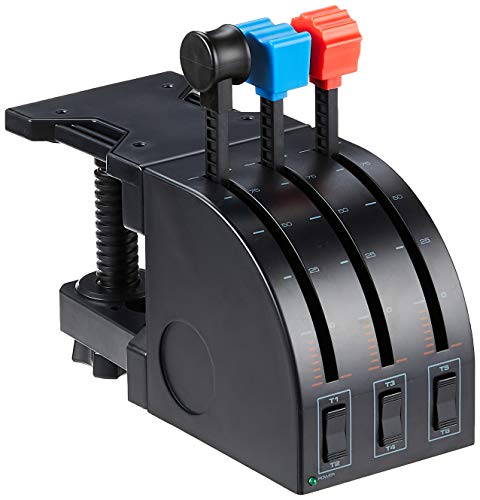
- Budget
- 3 levers
- Detents
- PC
X-Plane 12 Performance Score
- Throttle & Rudder35% 35
- Sensors20% 40
- Detent Feel15% 100
- Platforms15% 50
- Build Quality15% 50
Biggest contributor: detent feel (15% of the score), rated 100/100. How we score
Verdict for X-Plane 12
The Logitech G Pro Flight Throttle Quadrant suits X-Plane 12 pilots still setting power with a keyboard key, with three levers for throttle, prop and mixture. Logitech doesn't state the sensor type, it's PC only, and there's nothing beyond the levers and a few switches.
Updated October 2026
Pros & Cons for X-Plane 12
Strengths
- Three separate levers cover the three things a piston single actually needs: set power on the climb, set prop rpm, then lean the mixture in cruise without ever reaching for the keyboard, and X-Plane 12 lets you map each lever to its own axis with its own response curve.
- Logitech states the levers have detents — notches you can feel in the travel — so you can bring the power back to a repeatable position after takeoff while your eyes stay on the attitude indicator.
- The swappable lever handles mean you can configure it for what you fly: throttle, prop and mixture for a Cessna, or two throttles plus a third axis for a light twin so you can push both up together on a go-around. It's a sensible first quadrant to sit beside a yoke or a stick.
Trade-offs
- Logitech makes no contactless (Hall-effect) sensor claim for the levers, and levers without contactless sensors can get jittery as they age — you may see the throttle creep or twitch on a long cruise leg, which a recalibration or a small dead zone in X-Plane 12 usually settles.
- You get the levers and a few switches, nothing more: no autopilot panel for heading and altitude bugs, no extra lever for an airliner's second engine, which is what the next step up in price buys. It's an older design too, and Amazon's listing says it usually ships in 1 to 2 months, so order well ahead.
Full Specifications
- Type
- Configurable for any aircraft
- Levers
- 3
- Detents
- Yes
- Sensors
- Not stated by the maker
- Works on
- PC
- Released
- 2016
Frequently Asked Questions
Is this a good Throttle Quadrant for X-Plane 12?
Yes, for X-Plane 12 pilots flying light singles and twins who currently set power with a keyboard key or an on-screen slider; it scores 50.3/100 for this sim. It shines in general aviation, where three levers map cleanly to throttle, prop and mixture and X-Plane lets you shape each axis separately. It shows its limits in airliners and in any cockpit where you want an autopilot panel or a row of extra switches, because the levers are nearly all you get.
Is it worth the price for X-Plane 12?
For the money you're buying three assignable levers with detents and swappable handles, which is the core of piston power management and the one job a keyboard key does badly. The next step up in price buys more levers, an autopilot panel and contactless sensors, so decide whether you're building a general aviation setup or an airliner one before you spend.
What does it need to work?
Logitech lists it as PC only, so plan on running X-Plane 12 on a Windows PC and connecting the quadrant to a free USB port. X-Plane 12 isn't on Xbox or PS5, so console support doesn't come into it either way.
What else do I need with it?
This is one piece of a setup, not the whole thing: pair it with a yoke for general aviation or a stick, and add rudder pedals when you want to hold centerline in a crosswind landing. Mount it right against the yoke on the side of your throttle hand, so your hand drops onto the levers without hunting for them.
How should I configure this in X-Plane 12?
In X-Plane 12's joystick settings, assign one lever to throttle, one to prop and one to mixture, run the full travel of each so the sim sees the ends, and add a response curve per axis if the bottom of the throttle feels twitchy. Swap the lever handles to suit the aircraft, and learn where the detent — the notch you can feel in the travel — falls against your power setting, so you can pull back to climb power after takeoff without looking down.