Graphics Card · Microsoft Flight Simulator 2024
ASUS Dual Radeon RX 9060 XT 16GB GDDR6 Gaming Graphics Card
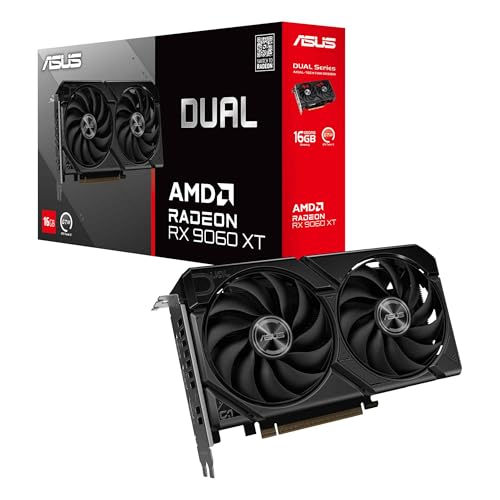
- Mid-Range
- 16 GB VRAM
This page contains affiliate links. As an Amazon Associate we earn from qualifying purchases.
MSFS Performance Score
- GPU Performance80% 40
- VRAM Capacity20% 100
Entry-level to mid-range GPU performance (40/100) suits 1080p to 1440p simulation — total score 52.0/100. How we score
Verdict for MSFS
The ASUS Dual RX 9060 XT 16GB suits 1080p screens in MSFS 2024, with 16 GB of graphics memory holding high textures over photogrammetry cities. It sits below the 1440p bar, so the next step up in price is what buys 1440p or VR headroom.
Updated October 2026
Pros & Cons for MSFS
Strengths
- At 1080p it keeps a rainy airliner arrival into a dense city airport playable, with FSR 3 upscaling built into MSFS 2024 to take some load off the card.
- The compact dual-fan air cooler drops into an older mid-tower without new case fans or radiator space, which matters when you're upgrading an ageing PC rather than building fresh.
- 16 GB of graphics memory matches the Ideal level in Microsoft's own spec, so texture resolution can stay high over photogrammetry cities — several alternatives for the money ship with less memory and start swapping textures at the same scenery.
Trade-offs
- A packed hub airport at 1440p with full AI traffic is past what this GPU handles comfortably, and VR over photogrammetry cities needs settings well down.
- In MSFS 2024, Radeon cards are limited to FSR 3 after FSR 4 was pulled from Sim Update 6, while GeForce RTX cards get DLSS 4.5 by default — the next step up in price buys both more GPU speed and the newer upscaler.
Full Specifications
- GPU
- AMD Radeon RX 9060 XT 16GB
- VRAM
- 16 GB
- Cooling
- Air
- Form factor
- Card
- VR ready
- Yes
- Released
- 2025
Frequently Asked Questions
Is this good for MSFS?
Yes, if you fly at 1080p — it scores 52.0/100 for MSFS 2024, and its graphics speed suits 1080p rather than 1440p. With 16 GB of graphics memory it holds high textures over busy airports and photogrammetry cities without running short of room. Push to 1440p, 4K or VR and you'll be trimming cloud quality and render scaling to keep things smooth.
Can I use a VR headset with this card?
VR is workable: the card is VR ready and 16 GB of graphics memory is plenty for the textures a headset loads, but the GPU itself is the limit because VR adds a large extra load on top of normal rendering. Treat it as a Quest 3-class headset card at modest settings — high-resolution headsets will ask more of it than it can give. Over photogrammetry cities, expect to lower render scaling and cloud quality, or lean on your headset's frame smoothing (reprojection, where the headset fills in extra frames).
Is it worth the price for MSFS?
For the money it gets the memory right: 16 GB matches Microsoft's Ideal level, so you aren't forced to cut texture resolution the way you are on similar cards with smaller memory buffers. What it skimps on is raw GPU speed, and that is exactly what the next step up in price buys you for comfortable 1440p and VR flying.
Is MSFS more CPU or GPU demanding?
As a standalone card it is scored 80% on GPU performance and 20% on graphics memory capacity, which gives 52.0/100. MSFS 2024 weights a full system 45% CPU and 40% GPU, so the processor you pair it with matters a lot: AI traffic, weather and terrain streaming at a busy airport lean on the CPU, while resolution, clouds and VR lean on this card.
What graphics settings should I use?
Start at 1080p on the High preset with FSR 3 set to Quality, since MSFS 2024 supports that upscaling natively on Radeon cards. When the GPU is the limit, which it usually will be here, drop the FSR mode a step and lower cloud quality before anything else, and only reduce texture resolution if graphics memory ever fills.