Flight Yoke · X-Plane 12
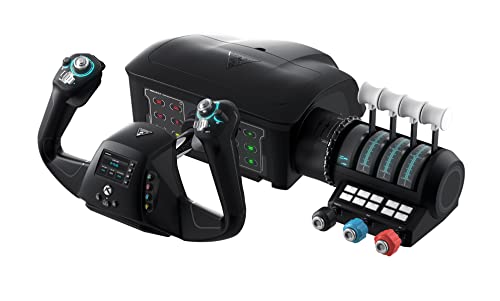
Turtle Beach VelocityOne Flight Universal Control System
- Mid-Range
- Hall-effect sensors
- PC and Xbox
- Throttle built in
This page contains affiliate links. As an Amazon Associate we earn from qualifying purchases.
X-Plane 12 Performance Score
- Feel & Centering25% 50
- Controls in the Box25% 95
- Sensors20% 100
- Platforms15% 100
- Build Quality15% 50
Biggest contributor: controls in the box (25% of the score), rated 95/100. How we score
Verdict for X-Plane 12
The Turtle Beach VelocityOne Flight suits simmers who want one box: yoke, two throttle levers, a trim wheel and built-in rudder controls, so you can taxi and trim a Cessna climb without extra hardware. It's wide, about 50 cm across, and the springs can feel sticky near center at first.
Updated October 2026
Pros & Cons for X-Plane 12
Strengths
- The main yoke axis uses a Hall-effect sensor — a contactless magnet, so nothing rubs and wears — which keeps the tiny pitch nudges that hold altitude in a Cessna reading the same way after months of flying.
- Almost everything is in the one unit: 2 throttle levers for power changes on the go-around, a trim wheel you roll to take the pressure off the yoke in the climb, built-in rudder controls for keeping the centerline on takeoff roll, and a color display with status lights so you can glance at gear or flap state without leaving the view.
- It fits the simmer coming off a gamepad or joystick who wants one purchase to fly light singles and airliners in X-Plane 12, with 180 degrees of roll for a proper hand-over-hand turn and 12 axes to assign; add rudder pedals later and the built-in rudder controls simply step aside.
Trade-offs
- Some owners say it feels a little sticky right around center when new and that quality varies between units, which shows up most on short final when you want small, smooth pitch corrections — a small null zone in X-Plane's per-axis settings helps, but it won't disguise stiction.
- The body is plastic and the maker lists centering springs with no mention of damping, so the yoke springs back rather than easing back; the next step up in price buys metal internals, damped centering, or a separate throttle quadrant with more levers for prop and mixture on a twin. It's also one wide unit, about 50 cm (19.5 in), so measure your desk first.
Full Specifications
- Sensors
- Hall effect (contactless)
- Throttle
- Built into the unit
- Throttle levers
- 2
- Trim wheel
- Yes
- Rudder controls
- Built in
- Panel
- Built-in display
- Centering
- Springs
- Roll
- 180°
- Build
- Plastic
- Works on
- PC, Xbox
- Released
- 2021
Frequently Asked Questions
Is this a good Flight Yoke for X-Plane 12?
Yes, and it scores 78.8/100 for X-Plane 12, which makes it a sensible single purchase for someone building a first proper cockpit. It shines because the throttle levers, trim wheel and rudder controls are already there, so you can taxi, rotate, trim for the climb and manage power without buying three more things. It shows its limits in the feel department — plain centering springs and a plastic shell mean it's a control set first and a precision pitch axis second.
Is it worth the price for X-Plane 12?
For the money you're buying four controls in one shell rather than a single, finely engineered yoke axis, which is good value if your desk and budget only stretch to one box. Spend more and you'd be looking at metal internals, damped centering and a separate quadrant; spend less and you usually give up the trim wheel, the rudder controls or the contactless sensors.
Which platforms does it work on?
X-Plane 12 runs on Windows PC and Mac, and this unit is listed for PC and Xbox, so on a Windows PC you're sorted — console licensing doesn't matter here because X-Plane isn't on consoles, but a console-licensed yoke like this still works fine on a PC. If you fly X-Plane on a Mac, check support before you buy, and on PC plug it straight into a USB port on the tower rather than a hub.
What else do I need with it?
Throttle and rudder are both built in — 2 levers and rudder controls in the unit — so you can fly from day one, though real rudder pedals are still the upgrade worth making for taxiing and holding the centerline in a crosswind landing. Beyond that you mainly need desk space and a solid, flat desk edge, because it's one wide unit at about 50 cm across.
How should I configure this in X-Plane 12?
In X-Plane 12, open the controls page first and confirm pitch, roll, the two throttle levers and the rudder axis all moved to the right assignments, and check that pitch isn't reversed — pull back should mean nose up. If it feels twitchy or grabby near center, add a small null zone (the dead zone where tiny movements are ignored) and soften the response curve on pitch and roll; then assign the trim wheel to elevator trim so you can roll off the back pressure in the climb instead of hunting for a key.